
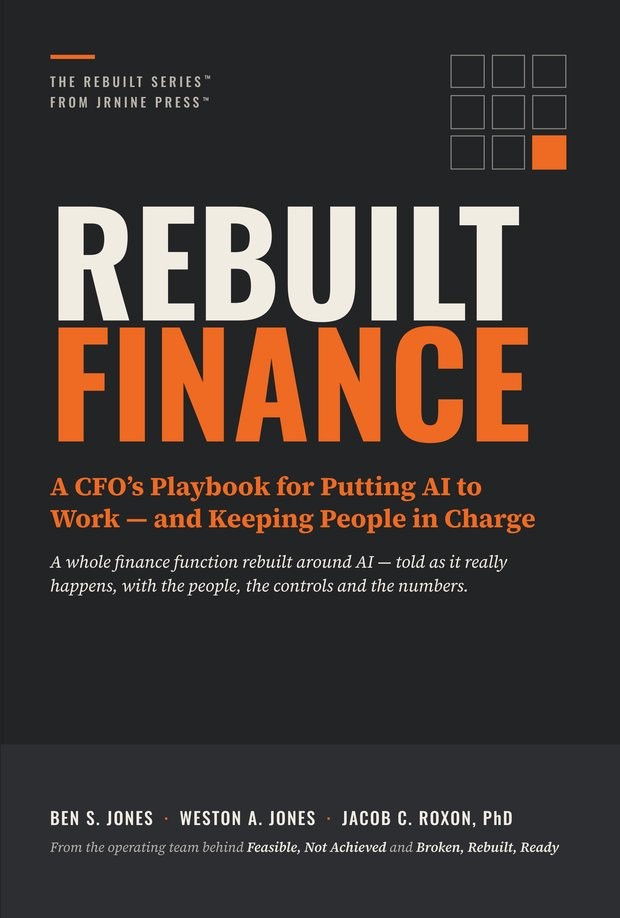
The book
Rebuilt
Finance.
A CFO’s Playbook for Putting AI to Work — and Keeping People in Charge
Design a finance function around AI from a clean sheet, check it against the team you have, and build it one release at a time. Follow one finance team through the hard parts, then use the same blueprint, and the free companion toolkit, in your own business.
Ben S. Jones · Weston A. Jones · Jacob C. Roxon, PhD
A story. A blueprint. Tools to use.
The story
Recognize your own team.
A healthy company, a finance team that mostly works, and a CFO asked to rebuild it before a crisis forces the issue.
The practical notes
Understand what to do.
Every chapter ends with questions to ask, where AI helps and people decide, what will be hard, and how to know it worked.
Your next step
Start on Monday.
Use the free companion toolkit at rebuiltfinance.ai: the activity inventory, agent job descriptions, release playbook, and Finance Rebuild Workplan.
The company, its finance team, and every person in the book are fictional composites. Figures in the story are illustrative, not results any organization should expect.
Find your starting point
Which problem needs your attention?
Finance can close the books, pay the suppliers, and pass the audit, and still learn about problems too late to matter.
Choose a topic to find relevant chapters and ways we can help.
Get the numbers in time to act.
Why it matters
A faster close only helps if leaders get the numbers while they can still act. Late or conflicting figures leave the business deciding without them.
Where to start
Look at the close, the reporting pack, and the forecast together. Decide which work an agent can do and where a person must check it.
Trade reports for earlier decisions.
Why it matters
Finance creates value through better and earlier decisions, not more reports. A long pack that few people use takes time from the work that matters.
Where to start
Agree one definition for each key number, cut what nobody uses, and answer the questions leaders actually ask.
Answer “where do I fit?” honestly.
Why it matters
When agents arrive, people quietly wonder what happens to their jobs. Without a clear answer, good people resist or leave, and their knowledge leaves with them.
Where to start
Give each responsibility one owner, make learning part of every week, and write down what experienced people know.
Choose the work before the tool.
Why it matters
Adding AI to today’s process makes the same work faster. It still learns about problems after they happen.
Where to start
Ask what AI people already use, with a promise that nobody gets in trouble. Then prove one release before you trust it.
40 chapters · Six parts
Find the chapters you need.
Read the whole story, or start with the question you are working through. Thirteen anchor chapters carry the main argument.
Suggested reading: [topic]. Chapters [chapters] are highlighted.
Part One | The Blueprint | Start with a clean sheet, decide where judgment lives, hire the agents, and prove the first release.
- 01Start with a Clean Sheet
- 02Write Down Everything Finance Does
- 03Decide Where Judgment Lives
- 04Hire the Agents: Roles, Owners, Hats and Prompt Packs
- 05Build the Workbench, the Knowledge Base and the Command Center
- 06Call an Amnesty and Reconcile the Blueprint with Reality
- 07Prove It in Purchase-to-Pay, Then Carry the Pattern
- 08Run It as One System
Part Two | The Releases | Build the rest of the function one area at a time, from expenses and the close to treasury, forecasting, and pricing.
- 09Expenses, Purchase Requests and the Supplier Help Line
- 10Order-to-Cash: Bill It Right the First Time
- 11The Close That Went Backward Before It Went Forward
- 12The Reporting Pack and the Financial Statements
- 13Payroll, Commissions and People Costs: Where Data Must Stay Inside
- 14Obligations, Tax and the Lender Certificate
- 15Every Contract, Read Every Day
- 16Audit Evidence by Default, and an Auditor Who Is Not Impressed
- 17Treasury and the Bank That Remembered
- 18Forecasting Around the Events That Move Cash
- 19Pricing, Profitability and Economic Profit
- 20The Business Questions Agent and the Tyler Stop
- 21The AI Dividend
Part Three | The People | New jobs, starting out, managers in the middle, late careers, weekly learning, and the people who push back.
- 22New Jobs and New Hats
- 23Starting Out When the Agents Do the Junior Work
- 24Managers in the Middle
- 25Leading Work You Cannot Personally Check
- 26Late Career: Len’s Playbook and Leaving Well
- 27Learning Every Week
- 28Everyday AI: Tools, Meetings and Working Principles
- 29Culture, Incentives and the People Who Push Back
Part Four | Trust, Control and Resilience | Controls inside the work, what to do when an agent goes wrong or a provider goes down, and data the agents can trust.
- 30Controls Inside the Flow
- 31When an Agent Goes Wrong
- 32When the Model Changes or the Provider Is Down
- 33Data the Agents Can Trust
Part Five | Value, Investment and Scale | Where finance earns a return, what AI really costs, adding an acquisition, and keeping the design current.
- 34Invest Where Finance Earns a Return, and Know What AI Really Costs
- 35Plugging In an Acquisition
- 36Keeping the Blueprint Alive
Part Six | The Finished Function | What changed and what did not, a day in the rebuilt function, and becoming the team the business calls first.
- 37Prove What Changed and What Did Not
- 38A Day in the Rebuilt Function
- 39Become the Function the Business Calls First
- 40When the Machines Get Better
Ends with the Toolkit at a Glance: the judgment tests, the three release stages, and the numbers behind the story. The full companion toolkit is free at rebuiltfinance.ai.
Read the whole story.
Forty chapters, every number shown, the misses kept in, and a free companion toolkit to start Monday.
Chapter 1 excerpt
Start with a Clean Sheet
Read an excerpt from Chapter 1.
The board met on the second Thursday of the month, and Mark Bennett had three slides nobody wanted to present.
The first showed the cash forecast finance had given the board at the start of the quarter and the cash the company had actually ended with. The gap was not large enough to threaten anything. It was large enough that Helen Ashby, who had chaired the board for six years and remembered every number anyone had ever given her, had asked about it twice before the meeting started. Behind her question sat a date. The company’s revolving credit line came up for renewal in fifteen months, and the bank had seen the same forecast.
The second slide was about a control. A supplier had been paid twice for the same delivery, once from each of two entities that had come with an acquisition and still kept separate vendor records. The duplicate had sat in the books for seven weeks. The auditors had found it, not finance.
The third slide was the one Mark had argued about with himself for a week. It was a single quotation from the operating leaders’ survey Vivian Cole had commissioned in the spring: “Finance tells us what happened. By the time they tell us, it’s too late to matter, and when we ask for help, the answer is usually no.”
Nobody in the room was surprised by any of it. That was the problem.
Helen let the silence run a little longer than was comfortable. Then she said what she had come to say.
“This is a good company. It’s growing. It’s profitable. The finance team works hard and passes its audit. None of us thinks finance is failing.” She looked at Mark. “But we think it can be something it isn’t yet. We want finance to see problems before they’re problems. We want it to help the business leaders run their businesses, not just score them. And we want the people in it to come out of this more capable than they went in.”
Vivian picked it up. They had clearly rehearsed. “We want you to rebuild finance as an AI-native function. Not a pilot. Not a project. The function.”
Excerpt from Rebuilt Finance. The company and its people are fictional composites.
Book availability
Explore the book.
Retail and ebook links are coming soon. For copies for your team, ask us directly.