
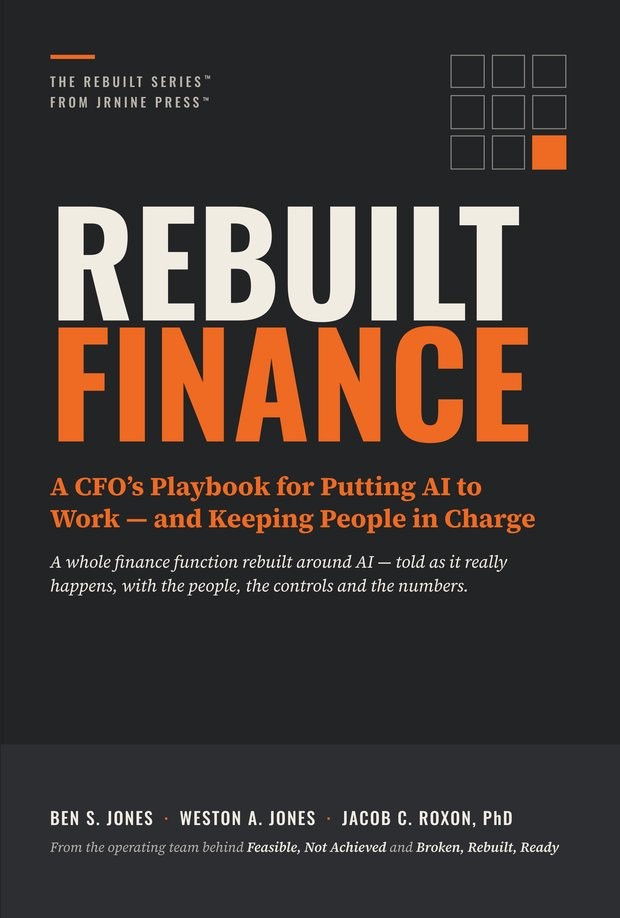
A CFO’s playbook for putting AI to work
Your finance team isn’t failing. That’s the problem.
It closes the books, pays the suppliers, and passes the audit, and still tells the business what happened after it is too late to matter. Rebuild finance around AI: from scorekeeper to business partner.
For CFOs, finance teams, owners, and investors. Written in plain language, with no hype.
From the authors of Feasible, Not Achieved and Broken, Rebuilt, Ready.
A story. A blueprint. Tools to use.
Sound familiar?
What the business says about finance.
None of it means finance is failing. The team closes the books, pays the suppliers, and passes the audit. It is built to report what happened, not to help decide what happens next.
Too late
“Finance tells us what happened. By the time they tell us, it’s too late to matter.”
Rebuilt: a soft close every morning, so leaders see the numbers while they can still act.
Chapter 11
Too many reports
“We get the reporting pack every month. Nobody on my team reads it.”
Rebuilt: one definition for every key number, and straight answers to the questions leaders actually ask.
Chapters 12 and 20
Scorekeeper
“Finance keeps score. It doesn’t help us run the business.”
Rebuilt: finance business partners who sit with sales, buying, and operations before the decisions are made.
Chapters 22 and 39
Blocker
“When we ask for help, the answer is usually no.”
Rebuilt: approvals the business understands, explained in plain terms, with the controls built into the work.
Chapters 20 and 30
Cash surprises
“We told the board how much cash we’d have. We were wrong, and our bank saw the same number.”
Rebuilt: a weekly cash forecast built from the bank accounts, with a range that shows how sure it is, so a shortfall shows up weeks ahead instead of after the quarter closes.
Chapters 17 and 18
Found too late
“A supplier was paid twice. The auditors found it, not finance.”
Rebuilt: controls inside the flow, so a problem is caught when it happens, not seven weeks later.
Chapter 30
Adding AI to today’s process won’t fix this. A faster version of today’s month-end, forecast, and approval chain is still today’s function. It still learns about problems after they happen.
From the preface. Lines above are paraphrased from the preface and Chapter 1; the company and its people are fictional.
For CEOs and boards
Three questions to ask your finance team.
The answers tell you whether finance is built to report on the business or to help you run it.
1
How many days after month-end before we see the numbers?
If the answer is more than a few, leaders are making decisions without them. In the story, the close starts at eleven days.
2
Who found the last control failure: finance, or the auditors?
Controls should catch a problem when it happens, not seven weeks later in someone else’s review.
3
How sure is the forecast, and can finance tell us?
A forecast should come with its own confidence. One you have to defend is one the bank will question too.
What it looks like when it’s done
One morning in the
rebuilt function.
The agents work overnight. People start the day on the work only people can do.
Payables lead
Starts on real problems, not data entry.
Overnight, the agents read and matched most invoices. Andre sees only what they couldn’t finish, plus a change to a supplier’s bank details held for independent checking. His first hour goes to fixing problems with suppliers.
Controller
Sees the close as a status, not a calendar.
Most reconciliations have already run during the month. Anika’s morning goes to three differences the agents couldn’t explain and one accrual that needs her judgment.
FP&A lead
Calls before it becomes a problem.
The forecasting agent flags a large customer paying later three weeks running. Owen calls the operating leader, not to report a problem, but to ask how finance can help before it becomes one.
CFO
Six things on one screen.
Cash today and where it is heading, exceptions sitting too long, the health of the agents, decisions due this week, commitments finance has made to the business, and anything flagged for Mark personally. Most mornings it takes four minutes.
The numbers in the story, including the misses.
11 → 2 days
Time to close: three days by the end of year one, two by the end of year two.
A year of budget, in cash*
Faster collections released cash roughly equal to a full year of finance’s budget, once. The book keeps it out of the payback, on purpose.
Not a headcount exercise
Hard savings came from outside spending: contractors, providers, software, and duplicate systems. The benefits for people reach across the company.
More value-added work
Less manual work, more analysis, judgment, and time with the business. New skills built every week. In year two, the CFO takes two weeks off during a close for the first time in eleven years.
And what went wrong: a result announced too early, a release rolled back, first-year savings smaller than hoped. The book keeps all of it in.
*Figures are illustrative story material, not results any organization should expect. The book shows the full payback, what the program cost, and a table of what happens if adoption is slower, costs run higher, or releases run late.
Voices from the book
You will recognize these people.
Every seat at the table has a stake in what finance becomes.
The operating leader
“That’s the first time finance has told me something while I could still do anything about it.”
Pete Gallagher
Head of Operations · Chapter 11
The board
“A partner that loses the keys isn’t a partner.”
Helen Ashby
Chair of the Board · Chapter 1
The finance team
“I’d rather give you our forecast for another quarter than give you a better-looking one I can’t defend.”
Owen Chen
Head of FP&A · Chapter 18
Characters in Rebuilt Finance. The company and its people are fictional.
The authors
Built by operators.
A finance executive, a transformation leader, and an AI builder. Between them, the people who run finance, change it, and build the AI.
30+ years in finance
EY audit and tax, UK finance director and controller, now EVP of Finance at a private equity firm.
16 years in AI and automation
Founded and led EY’s global Intelligent Automation practice. PwC’s U.S. Intelligent Automation Leader.
AI in production today
Leads enterprise AI, including agents, at a private-equity-owned global manufacturer.
CPA · CFA · CFP
Harvard Business School · University of Chicago MBA · MIT PhD.
Transformation programs that delivered billions of dollars in client savings, for startups, middle-market companies, private equity firms, and the Fortune 500.

Ben S. Jones
CPA, CFA, CFP · Finance, cash, and controls

Weston A. Jones
CPA, HBS · AI and business transformation

Jacob C. Roxon, PhD
PhD, MIT · AI and technology strategy
From the authors of
Feasible, Not Achieved
Why AI Transformation Stalls and the Nine Decisions That Finish It
Weston A. Jones and Jacob C. Roxon
Broken, Rebuilt, Ready
Turnarounds and Roll-Ups with AI That Sticks
Ben S. Jones, Weston A. Jones, and Jacob C. Roxon
See your finance team in it?
Get the book, and start Monday with the free toolkit. CEOs and boards can also request a leadership briefing.
Chapter 1 excerpt
Start with a Clean Sheet
Read an excerpt from Chapter 1.
The board met on the second Thursday of the month, and Mark Bennett had three slides nobody wanted to present.
The first showed the cash forecast finance had given the board at the start of the quarter and the cash the company had actually ended with. The gap was not large enough to threaten anything. It was large enough that Helen Ashby, who had chaired the board for six years and remembered every number anyone had ever given her, had asked about it twice before the meeting started. Behind her question sat a date. The company’s revolving credit line came up for renewal in fifteen months, and the bank had seen the same forecast.
The second slide was about a control. A supplier had been paid twice for the same delivery, once from each of two entities that had come with an acquisition and still kept separate vendor records. The duplicate had sat in the books for seven weeks. The auditors had found it, not finance.
The third slide was the one Mark had argued about with himself for a week. It was a single quotation from the operating leaders’ survey Vivian Cole had commissioned in the spring: “Finance tells us what happened. By the time they tell us, it’s too late to matter, and when we ask for help, the answer is usually no.”
Nobody in the room was surprised by any of it. That was the problem.
Helen let the silence run a little longer than was comfortable. Then she said what she had come to say.
“This is a good company. It’s growing. It’s profitable. The finance team works hard and passes its audit. None of us thinks finance is failing.” She looked at Mark. “But we think it can be something it isn’t yet. We want finance to see problems before they’re problems. We want it to help the business leaders run their businesses, not just score them. And we want the people in it to come out of this more capable than they went in.”
Vivian picked it up. They had clearly rehearsed. “We want you to rebuild finance as an AI-native function. Not a pilot. Not a project. The function.”
Excerpt from Rebuilt Finance. The company and its people are fictional composites.
Free companion toolkit
rebuiltfinance.ai
Start Monday with the people and tools you have.
The activity inventory, judgment test worksheet, agent job descriptions and prompt packs, Workbench reference, command center designs, amnesty kit, release playbook, quick wins, control matrix, learning program, cost guide, the numbers behind the story, and the Finance Rebuild Workplan.
Free with the book. Tell us where to send it.
Book availability
Explore the book.
Retail and ebook links are coming soon. For copies for your team, ask us directly.